
Home » Posts tagged 'Work' (Page 3)
Tag Archives: Work
Five workplace trends will shape life after lockdown

We are experiencing the biggest remote work experiment in history – but many are beginning to imagine life after lockdown. Amid unprecedented global job losses, concerns about transport infrastructure and the continuing need for workplace social distancing, governments are launching back-to-work plans.
Meanwhile, the latest US research reveals that 74% of businesses want some workers to permanently work remotely and business leaders are actively shedding leased office space – hinting that not everyone will go back to the office.
Here are five key trends that will shape the future of how we work.
1. Commuting will change forever
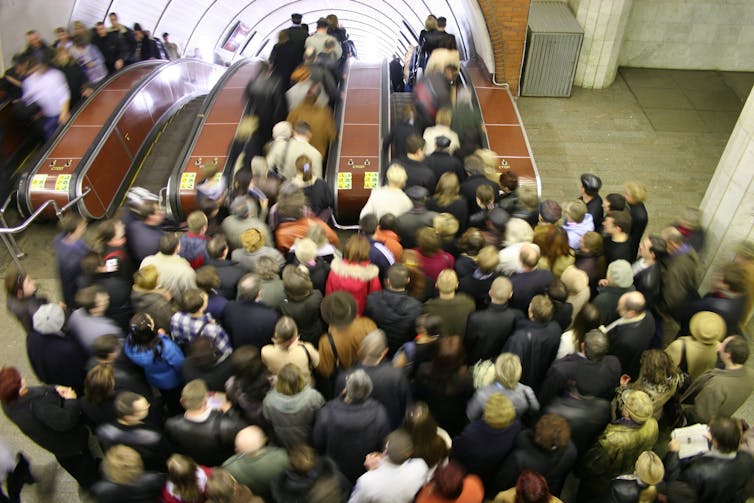
We might miss the social interaction of the office, but most don’t miss commuting. This was one of the key findings in my four-year remote work study.
Before lockdown, US commute times reached record levels and most UK workers spent more than a year of their lives travelling to and from work. People tell me that a hybrid strategy of working from home two days a week, is one ideal scenario.
Shutterstock
Those eager to go back to the office will have to wait. Many will need to work from home for weeks or months to come. The situation is fluid, but governments are drawing up plans for workers to stagger working times, so public transport is not overwhelmed.
The genie is out of the bottle, and commuting is not going back to how it was.
2. Bad email etiquette won’t be tolerated
Workplace communication is rapidly transforming and email is a case in point. More than ever, creating a clear separation between work and leisure time is vital.
Research repeatedly shows that sending out-of-hours emails is not only bad etiquette – but creates a coercive work culture that requires people to be available 24/7. Social scientists argue this turns us into worker/smartphone hybrids and causes stress and burnout. Expecting quick answers to email is increasingly seen as bullying.
Many now realise that colleagues might need to work flexibly due to caring responsibilities. Lockdown has encouraged a new acceptance of flexibility. But this shouldn’t extend to having a culture that expects people to be available all the time.
3. Video calls will be limited
Zoom calls will remain part of our lives – but we will change and adapt how we use them. Research shows that video calls are more draining and tiring than in-person meetings.

Shutterstock
While video calls are appropriate for some meetings, we don’t need to use them for all our communication. Research suggests many are shifting back to phone calls – which as one manager explained to me “feels more spontaneous and flows better”.
4. More co-working spaces will emerge
Workers forced to continue working from cramped living spaces are desperate for alternatives. When lockdown lifts they will turn to the cafes and co-working spaces that are still in business. Before COVID-19 hit, co-working spaces were projected to increase more than 40% worldwide.
The paradox of remote working is that people crave the flexibility but know that being around others boosts productivity. My research shows that over time remote workers crave the physical closeness that comes with just being alongside other people. It’s exactly why in 2017 IBM pulled many employees back into the office, despite having previously published a 2014 white paper in support of remote working.

Shutterstock
Local co-working spaces, as opposed to big investor-funded brands such as WeWork, will do well. Independent co-working spaces in some areas were thriving before COVID-19 – they may become more mainstream if they survive lockdown.
5. Could we become part-time digital nomads?
Digital nomads are extreme remote workers that post Instagram stories from exotic locations. Right now, that lifestyle seems unrelatable, impossible and to many unethical.
Nonetheless, many decently paid workers in New York, London and Paris are stuck in uncomfortably small flats, dreaming of escape from lockdown. As a housing manager recently confided to me: “London living without nightlife and culture, isn’t fun. Everyone wants to escape to somewhere outdoorsy when allowed. I’m not sure I approve but it’s understandable.”
For now, remote working from different locations is not allowed. But the allure of relocating to a picturesque location remains – and Brian Chesky, CEO of AirBnB, is banking on it. He sees COVID-19 as a business opportunity and told Bloomberg: “People are realising they can work remote … that’s a huge opportunity.”
Not all will agree – it could cause long-term sustainability issues – and many will not have this privilege. But when lockdown fully lifts, who’s to say more people will not work remotely from different parts of the world, beyond their living rooms.
Dave Cook, PhD Researcher, Anthropology, UCL
This article is republished from The Conversation under a Creative Commons license. Read the original article.
The Psychology of Successfully Working from Home
Prof Anna L Cox talks to Prof Joe Devlin from UCL Changing Minds about The Psychology of Successfully Working from Home
What crowdworkers can teach us about working at home
As schools across the UK closed their doors on Friday families focused on how they were going to create a coworking space at home. They spent their weekend moving furniture, clearing out spare rooms, refinding extension cable usually reserved for the xmas tree lights so as to create a new home office that could fit the whole family. We are fortunate enough to have a small extension that is open plan to our dining room that we can fit 3 of us into and we’ve squeezed an extra deskspace on the edge of the dining room so that we each have our own place to work.
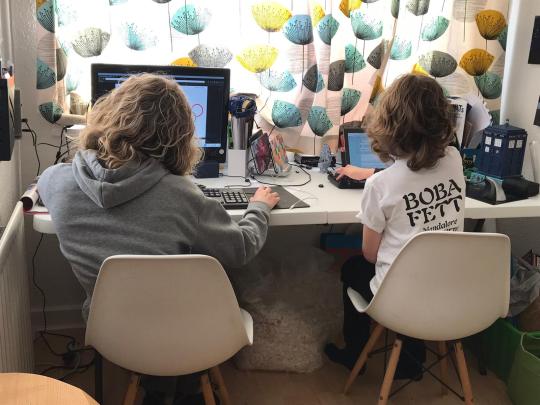
My new coworkers include a teen, a tween who are used to spending their days at school and doing a bit of homework at the end of the day. The fourth member of our team is a middle-aged man who is used to getting most of his ‘deep-work’ done in the office, and only using home for catching up on email. None of them are happy to be here! I, on the other hand, am used to having the place to myself to get on with ‘deep work’ and use my office for face to face meetings. I’ve been working at home for at least a day a week (usually more) for the last 16 years, first motivated by avoiding the crazy costs of commuting into London and then to facilitate the juggling of school pick-ups that comes with family life.
Our new normal means scheduling our day around the timetable of a secondary school. They’re encouraging the teen to do the work set during standard lesson time and of course that’s completely necessary for live online lessons. The tween is doing a fantastic job of following the lesson plans that have been emailed over by his teacher this morning. And I’ve realised that this timetable isn’t that different that one I followed on a writing retreat last year so this might actually work well for all of us. I don’t often take a 20 minute break in the middle of my morning but it was lovely to stand out on the patio in the sunshine whilst having a cup of tea.
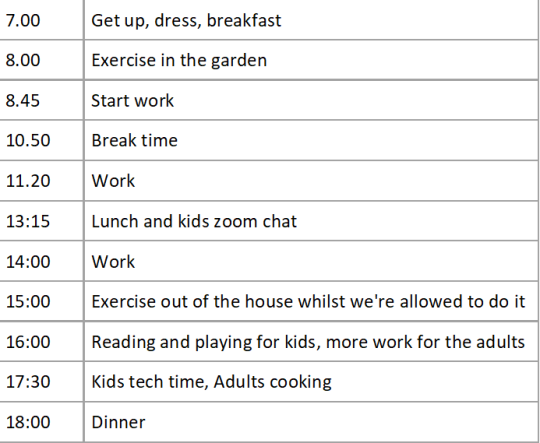
We all have different needs in this space. Two of us have online meetings with work colleagues and students, as well as video lectures to record. The teen is in the middle of an online lesson in google meets as I type – it seems that he doesn’t have to say anything (thank goodness) but I can still just about hear the teacher’s voice from his headphones. Being physically all in the same space isn’t going to work for all hours of the day so meetings and lecture recordings are going to have to be made from bedrooms. Connecting socially online is also important now we are distancing ourselves physically from everyone else and the kids need time to talk to their friends so we’ve set up daily meetings for them with online conferencing software so that they can hang out together.
We’re also trying to follow the WHO guidelines that state that children and youth aged 5–17 should accumulate at least 60 minutes of moderate- to vigorous-intensity physical activity daily https://www.who.int/dietphysicalactivity/factsheet_young_people/en/ Walks and runs around our local streets and park involve taking swerving routes away from people who don’t seem to have worked out that moving into single file when you are coming face to face with someone is probably a good idea! Yesterday a group stopped still as they saw us coming towards them – all 4 of them stood side by side across the path!
In this new coworking world, the research I’ve been doing with my PhD student Laura Lascau into the environments in which remote crowdworkers do their work has taken on new personal significance. There are many parallels between the challenges experienced by crowdworkers and those that many families will find themselves facing this week and I’ve tried to take on board what we have learnt when designing our new coworking arrangements. In the rest of this post I’ll summarise some of the findings from a paper we published last year and what we can learn from them:
Laura Lascau, Sandy J. J. Gould, Anna L. Cox, Elizaveta Karmannaya, and Duncan P. Brumby. 2019. Monotasking or Multitasking: Designing for Crowdworkers’ Preferences. In Proceedings of the 2019 CHI Conference on Human Factors in Computing Systems (CHI ’19). Association for Computing Machinery, New York, NY, USA, Paper 419, 1–14. DOI:https://doi.org/10.1145/3290605.3300649 (The full paper is available open access here https://discovery.ucl.ac.uk/id/eprint/10066164/1/1.%20monotasking-multitasking-CHI2019.pdf )
We surveyed people who work from home regularly about what works for them and have been able to extract some helpful tips for others that find themselves in this situation now.
Making an office space
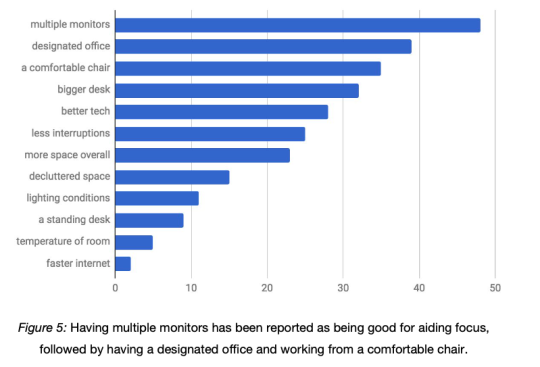
What changes would crowdworkers make to their spaces? Here are the top 4 things that they felt would improve their home work space.
- multiple monitors – our participants were clear that having multiple monitors would help them to get their work done more easily rather than working only from a small screen.
- have designated office spaces – they were also big fans of having a designated office space to work in. We pick up on this below when considering working around other people
- more comfortable chairs – having to made do with a corner of the sofa, or someone’s bed as a workspace was common. Having a comfortable chair was see
- larger desks – having a space to lay out everything they needed to complete their work was important
Working around other people
What are the most common challenges to focusing on work at home?
- presence of other people
- having the TV on
- pets
- digital distractions
About 40% of our participants worked from a shared space and struggled with integrating their demands of the different types of work they do with the constraints of their physical environment. As one of our participants told us:
“I would first and foremost move it into a private room. I miss out on numerous [jobs] because I am unable to record audio or video due to the fact others are making noise around me or would be in the webcam video. It also provides many distractions since it’s in the front room. A personal private room would be the best upgrade.”
Tip: Find out from everyone what kinds of activities they need to do in their day in order to identify what kind of spaces you need. Are you able to provide everyone with their own working space? If not, do you need a quiet working space for those doing ‘deep work’ and another place where people can have online meetings? Is this going to work every day or do you need to agree to rotate around? Check in frequently with each other to make sure everyone is getting the type of space they need.
Managing distractions
What helps workers focus on their work?
- quiet spaces,
- limited distractions,
- background entertainment (mainly listening to music)
Our participants told us about the strategies they use to manage distractions that come from other people:
“I use noise cancelling headphones. I tune out environmental noises or activities. I remain focused on what I’m doing. I do not engage in more than one activity at a time unless the [the work] require me to do so. I do not eat or listen to music while I work. I tend to work when the environment is calm rather than when I know those around me will be active.”
“I try to work during times I know the kids are being independent or napping.”
Tips: Sharing your work space with people who are prone to interrupt you is always difficult. Agreeing on a daily schedule that everyone agrees to might be helpful for helping to plan when you’re going get your work done. Remember that everyone feels that their own work is important so you can’t have one person dominating the way the space is being used. There’s going to have to be a lot of compromise.
If you have young children then talk to them about what they can be doing whilst you get on with your work. Some children can get lost in a book or happily play for hours with their toys. Most children can be occupied by tv or digital games. If you can, stick on some headphones and power through! Perhaps young children could be entertained by grandparents through videoconferencing software – they could read stories to them, or have a chat.
Work-life boundary management and leisure time
People vary in terms of how they tend to manage their work-life boundaries. Some people prioritise work, others non-work, and some try to do both. People also vary in terms of how separate they like to keep these parts of their lives: ‘integrators’ are happy switching frequently between one and the other, perhaps to the point where these doesn’t seem to be a boundary at all. ‘Separators’ like to keep them completely separate and wouldn’t ever contemplate working at home or at the weekend.
It won’t come as a great surprise to know that we saw that people who work from shared spaces such as family homes experience a far greater number of interruptions from personal matters when they were trying to work than those who were working from private spaces.
Tips: If you or your partner are separators then recognise that you’re likely to find this new co-working environment challenging and that it will take time to adapt to it. Again a schedule can be helpful here so that you block time for work and time for non-work. Remember to schedule non-work activities whether that’s time with friends, taking part in an online “pub” quiz or one of the many online exercise classes that have suddenly appeared.
Remote working: the new normal for many, but it comes with hidden risks – new research

Matej Kastelic
Many of us have had little choice but to resort to remote working in the midst of the coronavirus pandemic. It is just days since Google, Apple and Twitter were making headlines by ordering their employees to work from home, but you could now say the same about lots of companies.
Whatever you think about this style of working, the trend is increasing. Remote working was already growing fast – more than doubling since 2005 to 4.7 million workers in the US, for example. If you believe recent headlines, the transition is all too easy and seamless.
Yet the march towards this utopian future has been uneven – witness IBM’s decision to dump remote working several years ago, because it was preventing innovation and collaboration. I have just published research that highlights additional challenges and difficulties. And if people don’t approach remote working in the right way, they risk making their work lives worse.
Pros and cons
When discussing remote working, academics and the media have been split into opposing camps. The pro camp talk about cuttng out commutes, increasing quality family time and productivity and achieving a better work-life balance. Sceptics reply that flexibility comes at a cost. They warn about losing social interaction, nuance and community – and potentially becoming less productive. These give us mixed messages when we need certainty.
As an anthropologist, I’ve spent the past four years researching how people adjusted to becoming an extreme type of remote worker known as digital nomads. These workers move from country to country, always working online. I followed more than 50 in total, employed in a range of jobs including computer coding, graphic design, online marketing and travel journalism.
After an initial honeymoon period, remote working quickly became too isolating for over 25% of my participants. As one said, “Some aren’t naturally self-motivated, and no end of self-help books will change that”.
One solution turned out to be the coworking space. It gave a sense of community and face-to-face interaction, but more important was just to be around other workers – academic jargon for this is co-presence. As a remote employee working in ecommerce explained: “Just being around other folk working turbocharges your day.”
I completely understand this sentiment. I wrote most of this article in a coworking space, and just being around others tapping away at their keyboards creates a feeling of effortless productivity.
Yet things change quickly. Coworking spaces are not going to be an option for many people for a while. Some of those in house shares will be able to recreate the same environment at home. There are various forms of coworking space etiquette that can be adopted at home, such as having quiet zones for focused work and having separate areas for voice and video calls.
Digital discipline
If working near other people is important, the need for a disciplined work life is everything. For my research participants, this was the secret ingredient in sustaining remote working – whether the discipline was self-imposed or externally set by deadlines.
My participants never discussed discipline at first. The initial excitement of remote working made them productive for a while. But after a few months, motivation became harder. At this point, some participants gave up on this lifestyle.

Moshbidon
Those who thrived tended to be more strict, ensuring they went to coworking spaces every day and put phones and social media noise out of reach. Many also set up rituals. One graphic designer deliberately chose to work in a space that was 15 minutes walk from their home, to “mentally gear up for work” on his way in and to decompress before he got home.
Fascinatingly, here was a worker who had not only given up one office for another, but was recreating the daily commute. And just because coworking spaces are off limits at the moment it doesn’t mean you can’t consider equivalent rituals. It is still an option to build a short walk into the beginning and end of the working day, thereby creating a clear division between your home and work life.
Always on, always available
Digital technology may free people to work remotely in the first place, but it also causes unforeseen problems. My participants reported a growing expectation to be available 24/7, reflecting similar findings in other studies.
This is an issue for the entire workforce, but it is arguably exacerbated by remote working. Our 24/7 work culture didn’t happen overnight, or because of coercive managers. Instead, the perceived division between work and non-work has steadily disappeared over time, while few of us were paying attention.
Sociologist Judy Wajcman argues that this mentality is even restructuring how we think about time, as Silicon Valley designs devices and apps that urge us all on a never-ending quest for productivity and self-discipline. Besides work, the ways in which we read books, watch TV, exercise and meditate can now be timeboxed into app-sized chunks as well.
This culture has led some remote workers to experience mental health issues and burnout. Reflecting back on his burnout, one interviewee called Sam explained:
I didn’t have the concept of free time until I found myself scheduling four-hour meetings in my diary titled ‘downtime’. It’s insane; I look back at this period in my life and wonder why it took so long to burnout.

Aldeca Productions
We all need to keep an eye on this dangerous trend. It is crucial to set clear boundaries between home life and work and not put pressure on ourselves to be available outside working hours – particularly during a crisis when many of us will need to support family and friends.
Finally, remote working could well become permanent for many people. Many companies were encouraging staff to work elsewhere to reduce office costs before the outbreak, and this will probably be all the more attractive to the businesses that survive this crisis. One wonders if in ten years we will look back from our remote workstations and remember 2020 as the year we last went into the office. Either way, we need to be careful. Remote working always tantalises with the promise of freedom, but it can end up delivering the exact opposite.
Dave Cook, PhD Researcher, Anthropology, UCL
This article is republished from The Conversation under a Creative Commons license. Read the original article.
Working from home during COVID-19 pandemic
As increasing numbers of people find themselves transitioning from office based jobs to working from home, perhaps rather suddenly, I thought it might be useful to outline some hints and tips about how we can use technology to help deal with the challenges.
Get your technology set up
You’re going to need equipment. Although many of us check emails from our phones on a regular basis (and from all sorts of places) they’re not great devices for having to write a long reply, or for doing other work. So ideally you will have a laptop or desktop computer, or maybe even a tablet computer. Perhaps work has provided you with access to this but if not you might have your own computer that you can use.
There’s nothing more frustrating that trying to join an online meeting only to discover just beforehand that you have to download some software. So make sure that you have downloaded all the software you need and can access your systems at work where that is necessary. Accept that this will take time and set aside some time to do it.
Establish work home boundaries
One of the great things about working at home is that you can work whenever you want. One of the worst things about working at home is that you can work whenever you want! If you love what you do it is easy to start work as soon as you get up and just keep on doing it! Some people much prefer having work and non-work as very separate parts of their life. For them, having the two parts of their life so connected could be uncomfortable. If this is you then think about how you are going to protect your non-work time by creating boundaries around work time.

Here are some ideas
- Use an alarm to signal the start and end times to your working day. And as a reminder to take lunch breaks
- Plan to go for a walk before you start work around the same time you might start your commute. Getting a bit of fresh air and some gentle exercise can help you transition into work mode. Plan to do the same thing after work to help you transition back into home mode.
- If you can, create a space in your home which is your work space, and try to keep it separate and away from the areas where you relax. That might mean that the kitchen table is the best place for you to work.
- If you don’t have a space in your home to do that and are going to have to use a laptop from the sofa then choose a place where you can put the laptop at the end of the day so that you don’t keep seeing it as a reminder of work. If that’s not possible then you can always throw a blanket over it or put it behind the sofa.
Email can be particularly bad at invading our non-work time. In our research we identified ways people can create barriers between work and non-work using email technology. These strategies help you to avoid the situation where you are distracted by a work message when looking at personal messages, or vice versa
- If you have more than one device, consider using only one device for work email and keeping your non-work email on another.
- If you only have one device, try using one app for work email and a different one for non-work email.
Avoid distractions as much as possible but accept that they are likely to impact your productivity
Sometimes it is hard to concentrate on work because you find it boring or difficult. Working at home can make it even harder to concentrate because home can be full of distractions Not only can you just go and deal with the washing, or decide to watch an episode of your favourite tv show before you start, but you might also have family members, housemates or pets sat around wanting to distract you. Here are some tips for avoiding distractions:
- Again this is where having a special place to work that is away from all the distracting things can help. It’s harder to stay away from the TV when it’s right in front of you.
- You can try installing software like rescuetime that helps you track your work hours – this can be useful whether you think you’re likely to work too much or too little. Our research has also shown that estimating how much time you have spent on social media, and then using a tool like this to check how much time you really spent, can reduce stress.
- There are lots of apps you can use to help you avoid using social media whilst working – if you’re having to use a home computer to do your work then you might want to install something to help you
- In our research we have shown that people process their emails most efficiently if they try to reduce the number of times they check each day. Only checking once a day can be difficult but try setting key times that you will go to your inbox and stay out of it the rest of the time.
- Consider making the most of having flexibility over when you work – can you get up early and do a few hours whilst your partner looks after the kids, and then swap round?
- If you’re trying to work at home whilst also doing childcare, be realistic about what you can achieve. Think about what activities will keep the children occupied for an hour or so (a movie or a few hours on their console won’t harm them) and use that time to do your most important work.
Relaxing after work
Work can be stressful at the best of times. It’s important to find ways to switch off. This might be especially important when given that many people will also be feeling anxious about the current pandemic. The WHO offers some useful advice about how to deal with this:
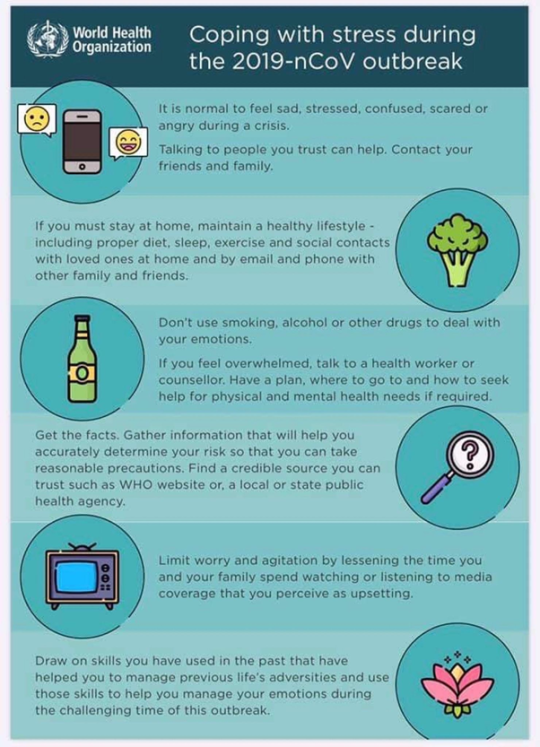
One of the activities that can help you to switch off from the stresses and strains of the day is to play videogames. We’re so used to reading in the media that videogames are bad for us that it has come as a surprise to some people to discover that our research has shown that they can be effective as a way to relax after work. It doesn’t seem to matter which kind of game you play as long as it’s one that you like. Many games contain a social element which might provide an additional benefit as you can use them as a way to connect with friends or family by playing over the internet.